Living in Katzrin: A Clear-Eyed Guide to Life on the Golan Heights
 Katzrin is often spoken of in quick slogans: “Capital of the Golan,” “quiet life,” “nature and vineyards,” and so on. Those fragments hide the actual question anyone should ask before relocating: what is the day-to-day reality of living in Katzrin? What works, what doesn’t, who thrives there, and who will struggle? This piece examines the town in practical terms: economy, housing, culture, education, climate, and long-term prospects. It does so without romanticizing, because the choice of where to live affects health, children’s futures, community stability, and financial resilience. Still, when evaluated soberly, living in Katzrin can be a strong option for many families, especially those seeking a grounded lifestyle, less noise, meaningful community ties, and strategic property value.
Living in Katzrin and Community Identity
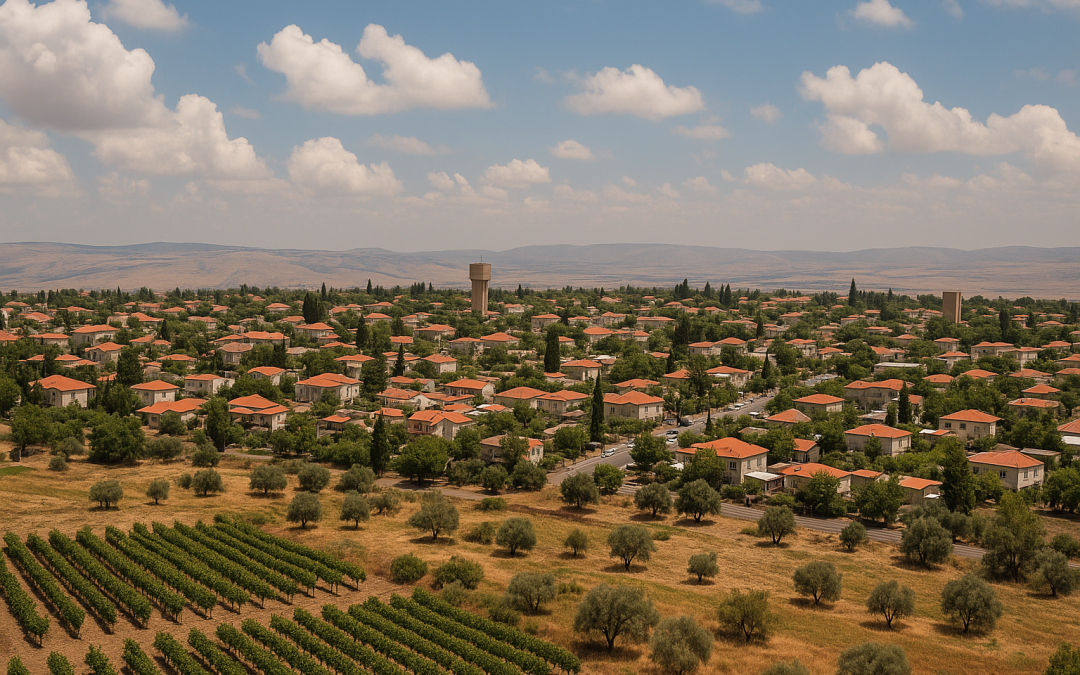
Katzrin is a relatively young town, founded in the 1970s, built deliberately, not haphazardly. This shapes its atmosphere. Instead of the dense sprawl of central Israel, you get wide streets, lower buildings, and neighborhoods that feel designed for actual living rather than constant motion. When people speak about living in Katzrin, they often describe a sense of being part of something intentional: a community built to grow, not merely survive.
Population stands roughly around 9,000 to 10,000, depending on seasonal movement and new neighborhood completions. It is a mix of secular, traditional, and religious families, native Israelis, immigrants, young couples, and retirees. Importantly, the mix is neither aggressively homogeneous nor tense. The dominant tone is practical coexistence with shared civic expectations.
Community life is structured around schools, youth movements, local cultural events, and everyday neighbor interactions. Crime rates are low, not due to heavy policing but because social norms are strong. Children walk freely; adults know one another; and social accountability remains meaningful. This is one of the largest qualitative advantages of living in Katzrin compared to many cities in the center.
Nature, Land, and the Physical Setting
The Golan Heights is not subtle. The land rises in terraces of basalt rock and wild grass, orchards, streams, and ancient ruins. Katzrin sits in the middle of this landscape, so the environment is present in daily life. This is not just about views; it is a physical reality that shapes mood, recreation, and community culture.
Walking outside is easy. Hiking does not require planning. Springs are close enough for spontaneous visits. For families, this means children grow up living in Katzrin with nature not as an occasional holiday treat, but as a baseline environment. That matters. It develops orientation, physical ability, connection to land, and a less digital-dominated childhood.
However, the environment also means winters are cold and windy, and summers can be dry. Anyone considering living in Katzrin should be prepared for strong seasonal shifts. Heating costs in winter can be higher than in coastal cities. Yet the climate also allows vineyards, orchards, and agricultural tourism to flourish, which ties into the local economy.
Housing and Cost of Living
Housing costs in Katzrin remain significantly below Tel Aviv, Jerusalem, and much of the central region. This is one of the primary drivers of migration. A family can purchase or rent a larger home with outdoor space rather than being confined to a small flat. This changes family dynamics and quality of life in direct and measurable ways. So housing in Katzrin is very good.
Detached homes, duplexes, and spacious apartments are normal, not luxury exceptions. New neighborhoods are being developed, meaning supply continues to expand. For first-time homeowners and young families, living in Katzrin provides a path toward property ownership that remains realistic.
Cost of living generally follows the national baseline, with some variation. Essentials are similar; certain services may be slightly more expensive due to distance; but savings arise largely from housing and reduced lifestyle pressure. Social competition and conspicuous consumption are less dominant. You do not need to dress, renovate, or perform success for social acceptance. That reduces stress and financial waste.
Work, Economy, and Employment Patterns
A legitimate concern when evaluating living in Katzrin is employment. Katzrin is not a major corporate center. Anyone needing daily access to Tel Aviv will find the commute impractical. However, a number of viable patterns exist:
-
Remote work is increasingly common. Many professionals in tech, design, consulting, education, and digital services work full or part-time from home.
-
Local employment exists in education, medical services, agriculture, tourism, retail, food production (including well-known wineries), light industry, and regional government roles.
-
Hybrid commuting to Haifa, Tiberias, Karmiel, Safed, and the Galilee is realistic with proper planning.
Those expecting the convenience of the center will find the adjustment difficult. Those who value autonomy, intentional time use, and stable professional rhythms often find that living in Katzrin supports focus and productivity better than urban environments.
Education and Childhood Environment
Schools in Katzrin include secular, religious, elementary, and high-school institutions, plus youth movements, community centers, music programs, and sports clubs. Class sizes are generally smaller than national averages, and parent-school relationships tend to be more active. Education quality varies by institution, as anywhere, but involvement and accountability are higher because people know one another.
Children living in Katzrin experience independence earlier. They walk to school. They ride bikes. They meet friends outside without structured supervision. This autonomy used to be normal across Israel but has largely disappeared in high-density urban zones. Here, it still exists. That is not sentimentality; it is a developmental advantage.
Religious and Cultural Life
Katzrin has synagogues of multiple styles, but none overpower the town culturally. Religious and secular families mix comfortably. Cultural life includes concerts, lectures, film screenings, seasonal fairs, wine festivals, and outdoor events. The local museum and ancient village site provide accessible history. There is a normalcy to community life that feels cohesive rather than performative.
If someone is evaluating living in Katzrin to escape social fragmentation, this is relevant. Katzrin does not demand conformity. It demands participation. That is a healthier social contract.
Daily Services, Healthcare, and Infrastructure
Healthcare services include local clinics and dental care, with hospitals accessible in Safed, Tiberias, and Haifa. Emergency response times are generally strong due to regional organization. Shopping, groceries, pharmacies, and essential services are present locally. For broader retail or specialized services, residents drive to Karmiel, Haifa, or Tiberias. For those accustomed to everything being five minutes away, this requires adjustment, but in practice, it becomes routine quickly.
Road access is reliable, though winter storms occasionally require caution. Public transport exists but is limited. Living in Katzrin realistically requires a car.
Security and Geopolitics
The Golan Heights is strategically sensitive, but Katzrin is not a frontline location. Security presence is professional and consistent. Residents live normal daily lives. The region is stable and calm on a day-to-day basis. Awareness, not fear, shapes local mindset. If someone is considering living in Katzrin but assumes it means living under constant threat, that assumption is inaccurate.
Future Prospects and Development
Katzrin continues to grow, both in population and in services. New residential areas, educational expansions, and tourism infrastructure are underway. The regional economy is increasingly tied to agri-tech, wine production, and nature-based tourism. As housing pressure continues in central Israel, demand for quality-of-life relocation will not vanish. This supports long-term property value stability.
Those choosing living in Katzrin early position themselves well for future appreciation while already benefiting from the present quality of life.
Who Thrives in Katzrin, and Who Struggles?
A rigorous evaluation requires clarity:
Katzrin suits people who:
-
Prioritize space, air, nature, and community over urban convenience.
-
Work remotely or in regionally accessible fields.
-
Value stability, low noise, and grounded social environment.
-
Want children to grow up with physical independence and outdoor life.
Katzrin does not suit people who:
-
Need immediate access to Tel Aviv corporate life.
-
Prefer anonymity over community visibility.
-
Want nightlife, high density cultural stimulation, or constant speed.
If someone tries living in Katzrin with expectations shaped by Tel Aviv or central suburban norms, they may feel isolated. If someone arrives ready to engage, participate, build, and root, they typically find a lifestyle that is both calmer and more meaningful.
Conclusion: A Realistic Opportunity for a Grounded Life
Living in Katzrin is not a marketing slogan. It is a choice to live at a different rhythm: slower where slowness matters, active where nature calls for movement, communal where anonymity breeds loneliness, and secure without constant hyper-vigilance.
It offers:
-
attainable home ownership,
-
space to breathe,
-
strong childhood environment,
-
reduced social pressure,
-
and a meaningful connection to land and community.
If your priorities include stability, grounded daily life, and the ability to raise a family in direct relationship with nature and community, living in Katzrin is not just viable. It is sensible.
Those who choose it do not typically look back. They look around, take a walk outside, breathe the air, and simply live.