
Donald Trump and Gaza Crisis: A Controversial Proposal
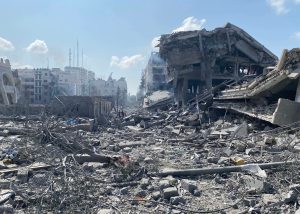
Palestinians inspect the damage following an Israeli airstrike on the El-Remal area in Gaza City
Trump’s comments align with his previous hardline stance on the Israeli-Palestinian conflict, in which he has consistently supported Israel’s right to defend itself while downplaying Palestinian sovereignty.
International Reactions: Outrage and Rejection
The response to Donald Trump’s proposal has been overwhelmingly negative. Palestinian officials have condemned the idea as reckless and inhumane, likening it to ethnic cleansing. Hamas, which governs Gaza, called Trump’s remarks “absurd and delusional,” emphasizing that the Palestinian people have no intention of abandoning their land.
“Trump’s plan is nothing short of a forced displacement scheme,” said a spokesperson for the Palestinian Authority. “This is a blatant violation of international law and an insult to the Palestinian people.”
Arab states, including Saudi Arabia, Jordan, and Egypt, have also dismissed the proposal. Saudi Arabia reaffirmed its commitment to a two-state solution, with East Jerusalem as the capital of an independent Palestinian state. Egyptian officials made it clear that they would not accept any forced relocation of Gazans into their territory.
“We will not be a party to any attempt to erase Palestinian identity and history,” an Egyptian government official told reporters.
Legal and Humanitarian Concerns
Legal experts and human rights organizations have pointed out that Trump’s proposal, if attempted, would violate numerous international laws. The forced displacement of an entire population is considered a war crime under the Geneva Conventions, and any attempt to relocate Gazans against their will would likely lead to legal challenges in international courts.
“Trump’s plan is not only unrealistic but also illegal under international humanitarian law,” said a representative from Human Rights Watch. “The idea of a forced transfer of Palestinians is deeply troubling and would set a dangerous precedent.”
Furthermore, the humanitarian crisis in Gaza remains dire. The ongoing conflict has left thousands of civilians dead and has displaced even more. Aid organizations have warned that any plan that does not prioritize the immediate needs of Gazans—such as food, medical supplies, and shelter—would be irresponsible.
Trump’s History with the Israeli-Palestinian Conflict
Trump’s latest remarks are consistent with his previous approach to Middle East policy. During his presidency (2017–2021), he made several controversial moves regarding Israel and Palestine, including recognizing Jerusalem as Israel’s capital and brokering the Abraham Accords, which normalized relations between Israel and several Arab nations.
His administration also cut aid to Palestinian refugees and closed the U.S. consulate in Jerusalem that served as a diplomatic channel with the Palestinian Authority. These decisions were widely viewed as favoring Israel and alienating the Palestinians from the peace process.
Potential Consequences of Trump’s Proposal
While Trump is not currently in office, his comments carry weight, particularly as he is a leading candidate in the 2024 U.S. presidential race. Should he return to the White House, his policies on Gaza and the broader Israeli-Palestinian conflict could shift U.S. foreign policy in a direction that exacerbates tensions.
Political analysts suggest that Trump’s proposal may be more about political posturing than a genuine policy plan. By making such bold statements, he solidifies his position with pro-Israel supporters while drawing attention away from other domestic political challenges.
“Trump’s rhetoric is aimed at energizing his base, which includes staunch supporters of Israel,” said a political analyst from the Brookings Institution. “Whether or not he actually intends to implement such a plan is another question altogether.”
What’s Next for Gaza?
As the humanitarian crisis in Gaza worsens, the focus remains on immediate relief efforts and diplomatic solutions. The Biden administration has taken a more measured approach, advocating for a ceasefire and increased humanitarian aid while working with regional partners to stabilize the situation.
The international community continues to push for a viable two-state solution, though the prospects for peace remain uncertain. Trump’s remarks have added another layer of complexity to an already volatile situation, leaving many to wonder what his potential return to power could mean for the future of Gaza.
For now, the world watches as the crisis unfolds, hoping for a resolution that prioritizes the rights and well-being of the Palestinian people.